
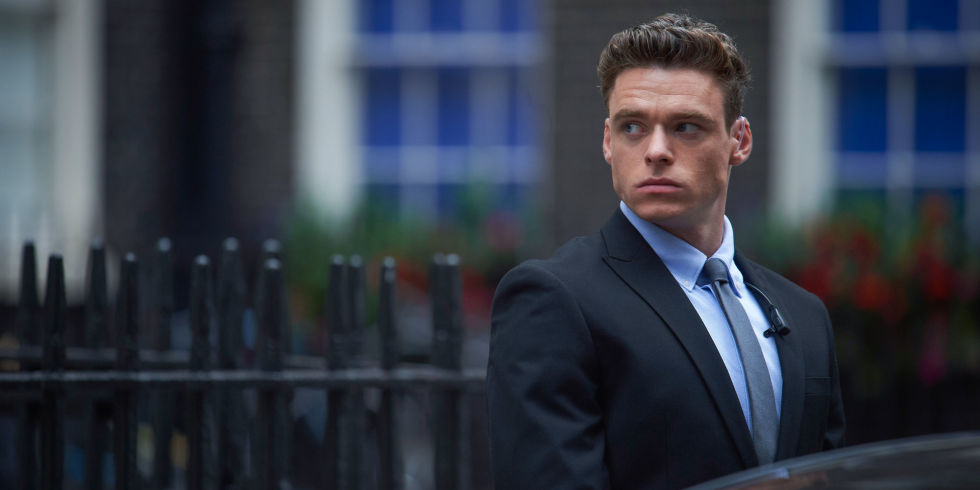
Jed Mercurio’s ‘Bodyguard’ has received nation-wide acclaim and has gripped viewers in a web of conspiracies, deceit and betrayal throughout its six-week run. From the first reviews of episode one, however, there seemed to be a dissonance between the way I felt about the programme and the way it was being celebrated across the media. To recap, the first episode begins with former soldier DS David Budd (Richard Madden) on a train journey with his children, which eventually leads to his entanglement in a terrorist plot. He meets Nadia Ali (Anjli Mohindra), a distinctly Muslim woman with a bomb strapped to her body who seems to have been pressured by her husband into committing a suicide bombing. And it is at this moment that I start to feel uncomfortable. My mother wears a hijab, my family and I are South Asian, my friends wear the abaya – we all resemble Nadia Ali in some form. Having to see our faces, our culture and our religion as a representation of religious terrorism is endlessly frustrating. I was apprehensive of every plot twist and conspiracy which other viewers were so eager to see revealed, in case it further vilified Islam – which is why I couldn’t enjoy the programme alongside the rest of the nation.
Over the course of the next four episodes of ‘Bodyguard’, it seemed that although Islamic terrorism was only to be used as a plot device as it wasn’t brought to the forefront of the main arc – that is until episode six. Here a weak and misguided attempt is made at breaking the stereotype of the submissive and oppressed Muslim woman. In the finale, Sergeant Louise Rayburn (Nina Toussaint-White) questions Nadia Ali about her involvement in an attempted attack on Budd’s children, and whether or not she is ‘just an innocent victim in all this, [a] pawn controlled by the real masterminds?’. What follows was one of the biggest plot twists in the programme, but for me is one of the most painful scenes of television I have viewed. Nadia strips off her timid, fraught guise and reveals that not only did she arrange the aforementioned attack, but she also built the bombs that had been used in several acts of terrorism throughout the programme; most notably the bomb used to kill Home Secretary Julia Montague (Keeley Hawes).
Here lies the problem: ‘Bodyguard’ uses an inherently negative motif, that of the oppressed Muslim woman, and inverts it not to challenge Islamophobic ideals but rather for shock value and to further a plot. If Mercurio truly wanted to battle stereotypes against Muslims he would not have merely swapped the ‘oppressed female’ trope for another negative characteristic. Challenging stereotypes is all about breaking down the negative connotation’s of one’s identity and replacing that with a conversation that enlightens one on their previously held assumptions. In a manner, it comes across as though Mercurio is projecting himself as the ‘saviour’ of Nadia Ali, and indeed Muslim women; he ‘rescues’ her from her typecast but for reasons which ultimately do not further any morally justifiable causes.
It would be remiss of me not to mention ‘The Riz Test’ – a set of criteria against which a piece of media can be judged in its depiction of Muslims. Within the first 20 minutes of ‘Bodyguard’s’ premiere episode, it had failed this test, breaking criteria number one in presenting an identifiable Muslim as a ‘perpetrator of Islamic terrorism’. The test’s namesake Riz Ahmed in ‘Riz Ahmed: Road to Englistan’ mentions that there are pieces of media, such as Christopher Morris’ ‘Four Lions’ (2010) that do subvert the stereotype of ‘brown terrorist’ but in order to ‘humanise [the] conversation and interrogate assumptions around it’. Indeed, this somewhat bitterly highlights the difference between the manner in which Mercurio presents his subverted stereotypes and pieces of media that actually challenge the stigma and ignorance certain clichés are based on.
‘Bodyguard’, amongst a slew of other programmes post 9/11, has cultivated the villainous stock character of the South Asian terrorist to distribute across an array of media platforms. When you look like these characters, it strikes in us an indescribable gut-wrenching fear that there will be some horrifying implication on your personal safety because of these negative characterisations. The portrayal of minorities in the media is influential on other people’s perception of us, and perpetuating a harmful image has implications outside of the realm of one’s television programme. Characters like Nadia Ali are not progressive, they are harmful. It is the moral responsibility of those in the writer’s rooms to see beyond a plot that utilises South Asian talent for cheap and tactless roles and begin a conversation in tearing down these stereotypes that have been built up through years of Islamophobia in the media.
 Aisha Reviews